World's Coating Innovator™
Home > Corrosion Protection > Corrosion Under Insulation – CUI
Corrosion Under Insulation – CUI
While corrosion prevention may seem expensive, it is only a fraction of the indirect costs of dealing with a pipe or infrastructure failure.
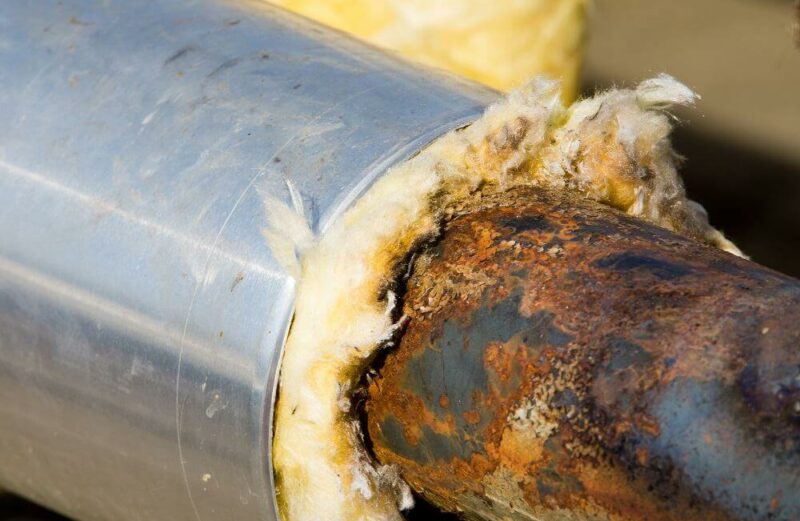
The new generation of ceramic designed coatings HPC, HSC, Super Therm® with Rust Grip® provide insulation without being affected by moisture and air flow. They can contain the heat at the surface level and therefore resist heat loss from the surface and holding more heat on the interior of the pipe or tank. The closed film can help prevent moisture and air to enter the coating film and therefore provide for a dramatic decrease in corrosion under insulation which is a major cause of corrosion problems in the field.
This is why the products will control “Corrosion Under Insulation” (CUI) by prohibiting the moisture load and air flows under the coatings to corrode the surfaces coated. In as much as heat ALWAYS goes to cold, the purpose of reflective insulation has been to control (slow down) the transmission of heat. Specially selected reflective ceramic compounds keeps the heat from loading onto the protected surface. If it doesn't load, there is no need for traditional insulation.
Reference
Thermal Insulation Coatings and Corrosion Controls
Author: J.E. Pritchett
Company: Superior Products International II, Inc.
Published abstract 12 Middle-East Corrosion Conference in Bahrain, February 3-6, 2008
Corrosion Under Insulation | Causes, Detection and Prevention
Author: C H O'Malley
Company: Altona Petrochemical Company
First published at the 27th ACA Corrosion Conference in 1987
Video above shows HPC® Coating being applied in 2011 at Gazprom (Russia's largest LPG Energy supplier to Europe) and shows a 550°C hot pipe insulated down to less than 40°C in just minutes…all without a shutdown or hot permit.
The insulation underneath the jacketing plays a critical role in either promoting or inhibiting corrosion. Many facilities have found that water almost always manages to find a way into the system despite jacketing and sealants. Studies from those facilities have shown that up to 60% of insulation that has been in service for more than 10 years will contain corrosive moisture.
Georgia-Pacific – EPA ENERGY STAR Award for HPC® Coating
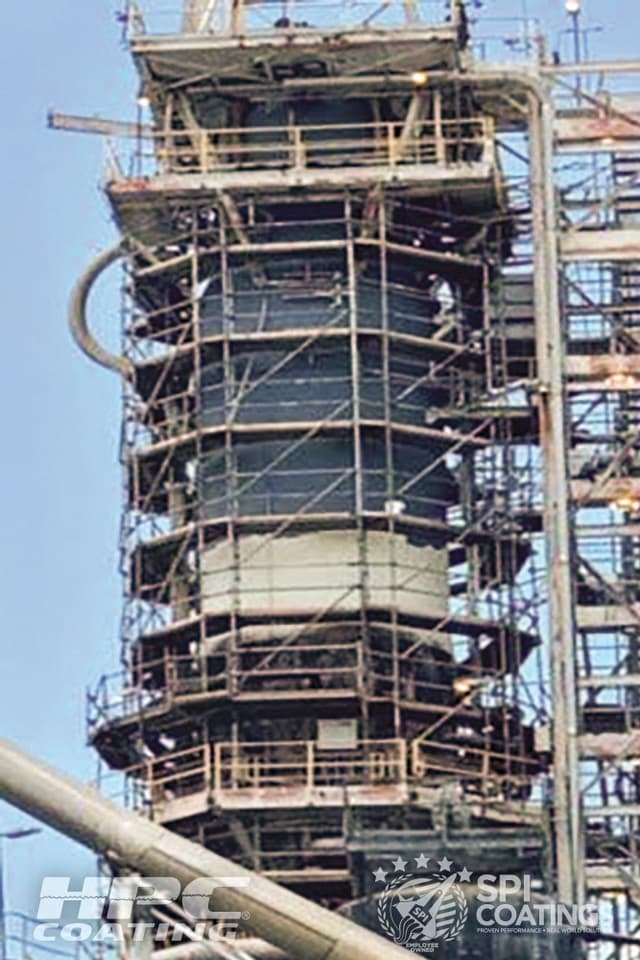
Three primary conditions cause corrosion under insulation:
1. Moisture must be present
Otherwise corrosion cannot occur. The dissolved oxygen (DO) in water creates the potential for corrosion. As DO content increases with temperature, so does the corrosion potential. Water can be introduced from outside the insulation or from inside (condensate). Common external sources of water are atmospheric moisture condensation, water from the cleaning of equipment or deluge systems, internal leaks, rainwater, and process liquid spillage.
2. Carbon steel (CS) and Stainless steel (SS) issues with water chemical content
The pH level of the moisture affects CS and can cause pitting and corrosion. Acidic contamination can come from the environment or by leaching contaminants from the insulation material. In the presence of applied or residual stress and temperatures exceeding 60°C (140°F) the chloride content of water can contribute to stress corrosion cracking (SCC) austenitic SS.
3. Temperatures must be conducive to corrosion
A problem is most likely to occur between continuous operating temperatures of 0 and 100°C (32 and 212°F) because liquid moisture can exist within this range and contribute to corrosion. In cyclic temperature systems such as dual temperature process or temperature variations during shutdowns liquid moisture can exist in insulation and corrosion can occur in a relatively short period of time.
Insulating Coatings
Super Therm®
Ceramic Coating Blocks 96.1% of Total Solar Heat
Super Therm® is a water-borne combination of high-performance aliphatic urethanes, elastomeric acrylics, and resin additives which produces a tough, yet flexible coating film that's been in operation since 1989. Designed for performance and durability, Super Therm® contains 4 unique ceramics to block up to 96.1% of Solar Radiational Heat entering a structure due to Visual Light, Ultra Violet (UV), and Infrared (IR). Learn More >
HPC® Coating
Get “High” Heat Insulation and Protection that Stops CUI
- HPC® Coating – Ambient up to 204°C / 400°F
- HPC®-INT – 204°C / 400°F up to 426°C / 800°F
- HPC®-HT – 426°C / 800°F up to 650°C / 1200°F
HPC® Coating, HPC®-INT and HPC®-HT is a single component water-based coating designed to insulate hot pipes or surfaces that load up to 650°C. Learn More >
HSC® Coating
Get “High” Heat Protection that Surpasses Conventional Insulation
HSC® Coating is designed to control heat transfer on surface temperatures up to 350°F / 176°C. It is water-borne, and extremely lightweight and smooth in appearance. Learn More
Corrosion Protection Coatings
Rust Grip®
The World's Toughest Encapsulation Coating
Rust Grip® is a single component urethane formula applied directly to rust or blasted metal surfaces. 6780 psi surface tensile strength. Extremely tough, anchors itself inside the pores of the metal surface or surface rust to block moisture and air from developing corrosion. Simple to use and extremely effective against all corrosive environments. Learn More >